Translate The Content in Your Local Language

Sunday, 10 May 2015

Students Create 3D Printed Tactile Map of Campus for Visually Impaired

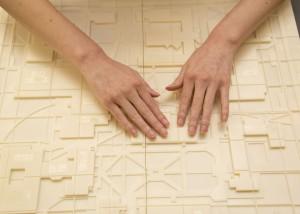
While 3D printing has most definitely blasted open a new world for designers and hobbyists, specific areas like cartography have received a real boon in progress. Because a map is all about being able to place yourself somewhere and visualize everything in a particular spot, it can be frustrating doing so only in 2D—requiring your mind to add the imaginary 3D element.
With new technology, and especially 3D printing, mapmakers are now able to put geographies and locales into tangible form. While this is extremely helpful—and exciting—to the general layperson, imagine how incredibly useful such maps are to the visually impaired, truly taking some of the darkness out of traveling on foot.
The technology of 3D printing is attractive for making communication tools for the visually impaired and blind, due to its obvious benefits in offering a raised surface that goes far beyond what Braille alone has to offer. While it’s amazing what we can do with digital design and 3D print, imagine the joy of being physically challenged and having new, easier—and even fun–ways to navigate the world.
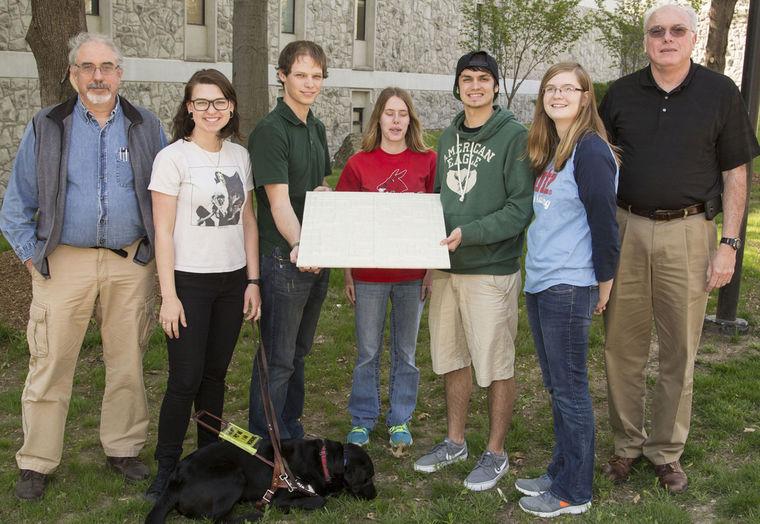
This all came together at the University of Central Missouri (UCM), with the added benefit of teaching students some new skills in technology and teamwork as they took on a comprehensive 3D printing and mapping project which evolved through working with peer and fellow student, Holly Carneal, who is blind.
Carneal’s trusty guide dog, Stella, is there for her when it comes to getting around campus as a social work major. As helpful as Stella is, providing both companionship and safety, she can’t provide specific directions.
With a mapmaking project looming close in Professor Jim Loch’s Introduction to Geology class this semester, a lightbulb went off as he thought of a great way to teach and help at the same time. His idea for a 3D printed campus map for Carneal and others also created an opportunity to bring together several different groups at the school for teamwork, which is always a crucial element in learning and preparing college students for jobs out in the real world.
3Dmap.closeup-300x214
Loch reached out to a number of people as he began thinking of a brilliant and complex project that would not only keep his students very busy and challenged in learning a number of new things, but would also work to help Carneal and other blind and visually impaired individuals on campus, as well as visitors.

Loch began communicating with the UCM Office of Accessibility Services coordinator Cathy Seeley, and Kyle Palmer, professor of drafting and design in the UCM School of Technology. With the idea to use the 3D printing technology available in UCM’s CADD program, the project began to form, along with the help of:
  • Alix Calon and Simon Misener, CADD students
  • Rachel Gibbs and Tyler Carpenter, student Braille specialists in Accessibility Service
  • Holly Carneal, social work major
“We had to figure out how to create the sidewalks that curve and replicate irregular angles and shapes,” Misener said, regarding the valuable learning experience afforded to all involved.
Amazingly, for a team that was taking on a number of new skills as well as new technology, the project was completed in one month, with 50 hours of printing time involved.
“It will not only help me get around better, but provide a valuable tool for any blind person visiting campus,” Carneal said.
554a65302f952.image
Carneal was able to offer suggestions that you wouldn’t think of perhaps unless actually experiencing the challenges of getting around campus—or any area—with visual impairment.

“We don’t have her experiences,” Calon said. “She shared her world with us and helped us create a product that is functional and will serve the purpose it was intended to serve.”
Rather than making the tactile map simply aesthetically appealing and correct to scale, as the normal inclination would be to do, Carneal suggested that for ease in actually understanding the map that all the buildings should be the same size, working as functional markers. Incorporating Braille into the tactile, 3D printed map, items were marked as follows:
  • Doorways were designated with tactile stars
  • Distance coordinates were marked for reference with grid lines
  • Text on the map is in Braille, and links building names to coordinates
“It was good to work on a real project for real customers with real deadlines. We had to develop our own resources and research the work of others,” Calon said.
The map, now stored in the Office of Accessibility Services, can be used by their staff in assisting students and anyone in need of the tactile, 3D printed directions.
We’ve reported on some other schools and entities creating 3D printed architecture and tactile maps in learning institutions and kiosks for the visually impaired. While many of these that are on public display are helpful to the blind, they are often helpful to everyone and offer a great opportunity to share the helpful benefits of 3D printing with the world.


Source: 3d print, 10th May 2015 

Customised wheelchairs, prosthetics finally coming of age in India


Customised wheelchairs and high-tech prosthetics are finally coming of age in India, allowing the differently abled to return to lives of voluntary movement and greater mobility. In this photo: Patients at Delhi's Indian Spinal Injuries Centre (ISIC)

******************************************************
In September 2014, Monica More, an 18-year-old student from Mumbai, picked up a pen and scribbled on a piece of paper; a feat she never thought she would be capable of again.

More had lost both arms in a train accident eight months earlier, while on her way to college. A year on, she is close to leading a normal life, thanks to an advanced pair of myoelectric prosthetic limbs.
"My arms had to be amputated below the elbows," says More, who took her Class 12 exams this year. "Holding a pen or writing seemed like a dream. But my new arms enable me to not only write, but also use a computer." More had to undergo multiple reconstructive surgeries before the artificial limbs came into her life.
"The artificial limbs are equipped with sensors that convert her brain signals into electronic signals, giving her voluntary control over her arm movements," says Dr Pradeep Bhosale, head of the orthopaedics department at Mumbai's KEM Hospital, and one of the doctors who treated More.
Customised wheelchairs and advanced prosthetic limb technology are finally coming of age in India, enabling Indians such as More to live with more dignity and independence, say medical experts. Built with better attachment systems and lighter materials, these advanced wheelchairs and prosthetic limbs also boast of improved control mechanisms to facilitate better movement.
"Customised wheelchairs were not available in India earlier," says Nekram Upadhyaya, head of assistive technology at Delhi's Indian Spinal Injuries Centre (ISIC). "But one wheelchair doesn't fit all. Patients need condition-specific modifications. For instance, quadriplegics and cerebral palsy patients require different types of assistance. You have to pay attention to their posture, breathing and other needs before assigning a suitable wheelchair. If the same type of wheelchair is given to these patients they will develop sores and their condition deteriorates further."
http://www.hindustantimes.com/Images/popup/2015/5/moving_on.jpg

Shashank Pandey, a 27-year-old paraplegic, suffered from bed sores because of using the wrong wheelchair.


"Government-issued wheelchairs are of no help. I had a heavy iron chair with fixed armrests, wheels and backrest. I felt impaired as I could not independently shift around," he says.


Mumbai college student Monica More had to have both arms amputated below the elbow after a train mishap, but is now able to write and type again, with the help of her new, high-tech prosthetic limbs. The prosthetics cost Rs22 lakh, a sum that her family raised partly through a crowdfunding campaign. (Praful Gangurde/ HT Photo)


ISIC operates on WHO guidelines and evaluates the physical and environmental conditions of patients before assigning wheelchairs. Pandey was later given an active aluminium wheelchair, which was lighter and suited to his body strength.
Working at ISIC's assistive technology department since 2006, Upadhyay creates locomotive solutions for patients suffering from paraplegia and multiple sclerosis. His team customises wheelchairs, depending on the patients' needs, posture and overall condition. ISIC also customises cars and homes for the differently abled.
Another hurdle to accessing state-of-the-art technology is affordability. At ISIC, Upadhyay and his team work to keep costs low. A customised wheelchair costs between Rs8,000 and Rs15,000 - against Rs40,000 to Rs2.5 lakh on the open market - but even that can be too much for many patients. More's prosthetic limbs, for instance, were developed by a German company and cost Rs22 lakh, a sum raised mostly through a crowdfunding campaign.
"Separate assistive technology departments should be set up at every government and private hospital," says Upadhyay, who has modified more than 5,000 wheelchairs over the past decade.
In some places, this is starting to happen. One example is Delhi's All India Institute of Medical Sciences (AIIMS). Among several prosthetic innovations at AIIMS is a form of walking callipers designed in collaboration with Michigan Technical University, set to be available at Rs20,000 to Rs25,000, as against Rs2.5 lakh in the US.
"They have features like kneeling and squatting, apart from helping the user propel forward in an almost natural manner - and it is because of government subsidisation that they cost one-tenth of what such callipers cost abroad," says Dr Rajesh Malhotra, professor at the department of orthopedics at AIIMS.
Then, of course, there is the psychological barrier to replacing one's limbs with a mechanical appendage.
"For me, the thought of having artificial limbs seemed uncomfortable at first," More admits. "But I never felt any discomfort once I started using them."


http://www.hindustantimes.com/Images/popup/2015/5/backontrack.jpg


Source: Hindustan Times , 10th May 2015

16 physically challenged youths get IT jobs after training


ICT Secretary Shyam Sundar Sikder handed over the appointment cards to the physically challenged graphic designers as the chief guest at a function at Creative IT Institute at Dhanmondi here today.


Addressing the function as the special guest, Director General of SME Department of Bangladesh Bank said the central bank with the support of Asian Development Bank (ADB) will introduce credit facilities for IT entrepreneurs at a 10 percent interest rate.
Director of Kaliakoir Hi-tech Project ANM Safiqul Islam, programme head of non-government organization CSID Iftekhar Ahmed, Chairman and CEO of Creative IT Monir Hussain and Deputy Managing Director Utpal Sarkar, spoke on the occasion, among others.
Shyam Sundar appreciated the unprecedented initiative of Creative IT to arrange jobs for physically challenged persons in IT sector. He laid emphasis on spreading the example of giving IT training to disabled persons at all levels of the society and bringing them to the mainstream of the national and social activities.
Monir Hussain said the institute has been providing training in number areas of graphic design to physically challenged persons for the last few years out of its social responsibility.
Out them, 16 students have qualified for working in the international market of outsourcing and proved that they are not disabled, but they have ability in other ways, he said, adding the disabled persons can do many things much better than normal persons.


Source: Big News Network, 6th May 2015 

No national data on HIV/AIDS among differently-abled, reveals RTI

The Capital has nine antiretroviral treatment centres, but none of them has information on the alternate format for blind or sign language interpreters for deaf people, who are living with HIV.


This is as per a Right to Information reply obtained by disability rights activist Satendra Singh from University College of Medical Sciences and GTB Hospital, Delhi.

Stating that persons with disabilities are the missing voices in India’s national AIDS response, the physician noted that in the first report of its kind, UNAIDS Gap report 2014 had identified 12 populations at higher risk of HIV (of which people with physical disability is one) and emphasised covering these to close the gap.


This Gap report estimates that India has the third largest number of people living with HIV in the world and accounts for about 4 out of 10 people living with HIV in the region.


“The National AIDS Control Organisation (NACO) in its response to an RTI had noted that they do not have any national data on HIV/AIDS prevalence among people with disabilities,’’ said Dr. Singh.


He added that the NACO annual report of 2013-14 too does not feature a single word with ‘disability’ or ‘persons with disabilities’. Disability is also not mentioned in the HIV/AIDS (Prevention & Control) Bill 2014 as introduced in the Rajya Sabha.


“The Delhi State AIDS Control Society (DSACS) has accepted the lacunae and responded stating that suggestions have been conveyed to NACO to include people with disabilities living with HIV in national response, convert all info on sexual and reproductive services AIDS/HIV in accessible format, prevalence among disabled to be included in next survey, disability questions to be used in existing survey,” said Dr. Singh.


“We have also suggested that State Commissioner of Disabilities be part of State AIDS Control & Prevention Societies. Also, the Medical Council of India has written to include disability studies to be part of the MBBS curriculum and Delhi Medical Council to issue instructions to Hospitals and Clinics to be disabled friendly,” he added.


People living with disability (PWD) are world’s largest minority and hence part of every social group included as vulnerable and risk group in UNAIDS Gap report.


“There is also low awareness of HIV among PWDs. The 2007 survey done in rural areas of India revealed the fact that one-fifth of people interviewed had never heard of HIV and is a cause for great concern. People with mental or developmental disabilities generally lack the ability to develop the social skills to recognise predatory behaviour and avoid vulnerable situation. The situation is same for wheelchair users isolated in homes and restricted from communicating with society,” noted Dr. Singh.


Source: The Hindu, 10th May 2015 

Let's Talk About Sex--And The Differently-Abled--Baby

Shonali Bose's tour de force, Margarita With A Straw, should be an interesting starting point for a debate on the sexual rights of the differently-abled. Interesting because the protagonist--played by Kalki Koechlin--shakes off social barriers by actually doing something about her desires.

DISABILITY INDIA

Not every person with disabilities is able to break through; social pressure to be asexual generally triumphs. There is little recognition of--or thought invested in--the sexual rights of the differently-abled. And, as with most social tragedies, it's the women who suffer the most.

According to the 2011 Census, the differently-abled account for 2.21% of the population that is approximately 26.8 million people. Of these, 11.8 million are women.

These numbers have been contested. The World Health Organization, using a broader definition of disability to include conditions such as diabetes and cardiovascular disease, estimates that 70 million Indians suffer from disabilities.

No matter which estimate you accept, the fact is that this is a sexually invisible group. In fact, their sexual rights have been systematically throttled. They have been subjected to segregation, confinement and even forced sterilisation.

Studies on this subject are alarming. A report by Disabled People's International (India) and its partners on the Committee on the Elimination of Discrimination Against Women in September 2013 said: "Almost 80% of women with disabilities are victims of violence and they are four times more likely than other women to suffer sexual violence."

They are looked upon as objects of pity or a burden, leading to low self-esteem and a poor body image. In a country where sex education is rare and virtually non-existent for the differently-abled, they face discrimination and humiliation from even those who should know better--doctors, for instance.
disability india

Priority 1: Awareness

Renu Addlakha, of the Centre for Women's Development Studies, wrote in 'A Training Manual for Professionals Working with Adolescents and Young People with Physical Disabilities', as reported by Livemint.com: "Sex education programmes for the disabled have by and large targeted the mentally disabled who are regarded as particularly vulnerable to sexual victimisation due to difficulties in general understanding and social judgement. But it is not only the mentally disabled who require special sex education programmes."

Indeed, it's the parents who may need to be educated as much. For instance, many believe it's a sin for children with disabilities to masturbate. They fail to understand that the physical needs of the differently-abled are the same as others'.

This is recognised by various international treaties, including ones that India is a signatory to. For instance, the Biwako Millennium Framework for an inclusive society and the United Nations Convention on Protection and Promotion of the Rights and Dignity of Persons with Disabilities.

The differently-abled are keen to understand their feelings. This is backed by research conducted by the likes of the Family Planning Association in Northern Ireland, which found that two-thirds of people with learning disabilities want to know more about sex and relationships.

There's no reason to believe that the numbers would be different in India. That's why it's time to break the silence; the voices of the differently-abled, activists, lawyers, counsellors and academicians need to get louder and amplified by the media. That the differently-abled have a desire for love, sex and relationships needs to be asserted repeatedly.

Priority 2: A Legal Underpinning


India needs a legal framework that goes beyond job reservations and norms for buildings to be differently-abled-friendly. The government did introduce the Rights of Persons with Disabilities Bill, 2014, but not everyone was convinced about the sections dealing with reproductive rights.

India's track record on this front has been poor. The country passed the Persons with Disabilities (Equal Opportunities, Protection of Rights and Full Participation) Bill as late as 1995. It defines a differently-abled person as one with at least 40% of any disability, but activists said it was not enough. It was only in April 2010 that the government formed a committee to draft a new law aligned with the United Nations Convention on Rights of Persons with Disabilities. The draft Bill submitted in June 2011 included in a comprehensive section on the reproductive rights of differently-abled women. However, a revised version drastically shortened that section, merely mentioning that all programmes be sensitive to gender needs.

Priority 3: Sensitisation

Incidentally, Margarita With A Straw is not the only film made on the sexuality of the differently-abled. The Sessions, an Oscar-nominated film released in 2012, was based on the true story of a man with an iron lung who loses his virginity to a sexual surrogate.


Ash King was helped by TLC Trust, a UK organisation that connects people with disabilities to sex workers. TLC's founder, sex therapist Tuppy Owens, told 'The Guardian': "Finding a sex worker who will talk, teach, accept... is a bit of a boost of confidence and self-esteem."


Perhaps this is a distant dream in India, but it's an example of the empathetic approach that is possible. That some of TLC's bookings are made by parents shows the difference an enlightened parent of caregiver can make.

Priority 4: Learn From Others

India can take a cue from the Australian state of Victoria, where all citizens--including the disabled--aged 16 or older are entitled to sexual privacy and choice.

Like in Victoria, our sex education classes must stress on:

• Teaching that the differently-abled can have fulfilling sex lives.

• Greater integration of differently-abled children in schools to sensitise others from a young age.

• Delivering information in a manner that a differently-abled person can understand.

• Giving parents information to deal with the challenges their children face.

• Underscoring that people with disabilities can be successful partners and parents..

None of this will be easy. Expect pushback, even from the more educated and affluent.
Scott Hamilton, champion figure skater, said, "The only disability in life is a bad attitude." It's precisely the disability society suffers from.

Source : Huffington Post , 2nd May 2015

Jubail needs women friendly gyms


Jubail needs women friendly gyms

More and more women in Jubail are joining gyms to get healthy despite a lack of sports facilities in the city, Asharq Al-Awsat newspaper reported.
 
As a result, many women are calling for more women-friendly gyms, lower gym membership fees and improved female-friendly privacy at centers.
 
Noora Al-Harthy regularly goes to a gym. She said that women in Jubail have limited access to gyms as the ones in the city are situated in far-flung areas.
 
“Some women get discouraged by the high fees while others are discouraged by the very unfriendly locations of these gyms. As a result, many women stay at home and don’t bother working out,” said Al-Harthy.
 
Rana Al-Qahtani said many women have become obese because they cannot afford to join gyms. “I’m sure women will go to gyms and become more interested if they had several options. Unfortunately, there’s a large number of women who opt for plastic surgery in order to look slim; they cannot continue living overweight and are unable to visit gyms because of the extortionate amounts that gyms charge,” said Al-Qahtani.
 
Just like men, women need to work out to feel invigorated and fight stress, she said, adding that many gyms are not suitably equipped to attract women and make them want to engage in physical activities.
 
Lujain Al-Kaltham feels gyms also need to provide facilities for disabled women and the elderly. “This is an important section of society that needs our moral support and encouragement. There are many physically challenged women who often do not go out and live bitter and boring lives as they do not have many choices when it comes to gyms,” she said.
 
These views were echoed by Reham Al-Saif, who complained that gyms offer limited services to women and overcharge. “Many women have recently signed up to gyms to lose weight and keep shape; this is a good indicator of high public awareness. The problem lies in the fact that most sports centers are small and are unable to handle the large numbers of women members,” she said.
 
“I signed up to a gym and shed 13 kilograms. But after a while, I got fed up and stopped going to the gym because I had to wait a long time to use machines. Besides, there’s no restricted time for using machines. I found that a great deal of my day was spent at the gym when I should’ve spent only an hour or two,” she said.
 
Khloud Al-Zain is a female trainer at a gym in Dammam. “Obese women need to spend a lot longer in order to shed extra weight and improve their fitness. Good things come to those who wait. The more a person works out, the better will be the results,” she said.
 
She also advised people working out to watch what they eat. “This will ensure quicker results. Some recent studies have shown that working out has the same effect as anti-depressants—working out helps women maintain a good psychological state,” she added.


Source: Saudi Gazette, 8th May 2015 

Admn distributes assistive devices among children with special needs - Chandigarh

With an objective to connect children with special needs (CWSN) with the main education system, the Sarva Shiksha Abhiyan (SSA) and the Rashtriya Madhyamik Shiksha Abhiyan (RMSA) have jointly organised a five-day assistive devices distribution camp for such children in Amritsar district.
Under the supervision of Amritsar deputy commissioner (DC) Ravi Bhagat, the district education authorities in association with the Artificial Limbs Manufacturing Corporation of India (ALIMCO), a Government of India undertaking under the ministry of social justice and empowerment, distributed assistive devices among more than 280 children, who during an assessment camp in October 2014 had been recommended to get the devices, said Dharminder Singh, district resource person, department of inclusive education for disabled, SSA.
The project is jointly funded by the Centre (60%) and the Punjab government (40%).
“As many as 425 children with special needs from various government schools and others had participated in the October 2014 assessment camp, while only 284 were recommended to get the assistive device. A single assistive devise costs Rs 4,000-Rs 6,000 approximately,” said the resource person.
The five-day camp was inaugurated at Government Elementary School, Sharifpura, here by Inderbir Singh Bolaria, chief parliamentary secretary (CPS, education), on May 4 and was divided block-wise for the distribution of assistive devices.
On Day 1 on Monday, devices were distributed among the children from Amritsar education blocks one, two, three and four; while on Day 2, children from five, six and Verka block got the device.

On the third day on Thursday, the distribution camp was shifted to Ajnala, where the devices were distributed among the children from Ajnala and Chugavan.

On the fourth day, the camp was shifted to Baba Bakala, where devices were distributed among the children from Rayya, Jandiala Guru and Tarsika.
On Friday, the camp will be shifted to Government Elementary School, Nag Kalan, under which Majitha 1 and 2 blocks will be covered, where the DC will be meeting the families of these special children.

Amritsar district education officer (DEO) Satish Kumar said: “Under the project, the children with special needs from 6-14 years of age and also children studying in Classes 9-12 had been given devises like wheelchair, crutches, artificial limbs, tri-cycles, hearing aids etc, with an aim to bring them to the school, educate them and connect them with normal children.”

Bhagat said, “The project will provide the much-needed support to the people who couldn’t afford assistive devise for their children. At the camp, the children and their families get a chance to interact with professionals and seek guidance from them.”
“Considering the success of the camp, I have asked for a survey by the ministry of social justice and empowerment, which will include physically-challenged people of all age groups and genders from across the district,” the DC added.


Source: Hindustan Times , 7th May 2015 

Within Arm's Reach: Students 3D Printing Prosthetic Hands


Students designed custom modifications for the 3D printed prosthetic hands, such as light-up "tendons" for this child's hand.


One group designed a removeable part in the palm.


For children it's designed to hold superhero adaptations, and for adults, a magnet or flashlight.


Most of the groups only saw an image of their client's hand on a table next to a ruler and quarter.


The "demo-hand" is a larger model hand that had been 3D printed.


One group designed a cane with a proximity sensor that beeps to alert the user when objects are getting closer.


T

The proximity sensor on the bottom of this cane is designed to alert the user when object are getting closer.


Professor Jonathan Muckell (at right) talks with students.


The e-NABLE project is an open-source, online community project.


One of the children who recieved a hand in December, when UAlbany students donated four 3D printed prosthetics.


3D printing has grown in a few short years from the pages of science fiction to a reality, with machines now found on college campuses and even private homes. 3D printed products are making a big difference in the Capital Region.
“I’m Frank Williams, I live in Ghent, New York, I was a union carpenter, and all around construction and motorcycle enthusiast, and I had an accident and lost the use of my right hand. “ 
After suffering a motorcycle accident two years ago, Frank Williams is one of several people with physical disabilities who are getting a helping hand from a group of University at Albany students. A physical computing class in the Informatics department is using 3D printing technology to make custom prosthetics.
Led by their professor, Jonathan Muckell, the students are working on these prosthetics as their final projects. The theme: accessibility and disability technologies.
"This is part of the e-NABLE project, which is a volunteer community of people who print custom fit prosthetic hands for people who are missing fingers, and sometimes most of their palm,” Muckell said.
The prosthetic hands are printed with brightly colored, light-weight plastic filament. It can take 30 hours for a printer to complete one hand.
Other technologies developed by the students include a cane with a proximity sensor that alerts the user as objects get closer, and a device to help people with mobility issues know when a bathroom is occupied.
3D printers are becoming more common, used to print everything from living human cells to artfully designed food. RPI, Siena College, SUNY New Paltz and UMass Amherst are just a few of the colleges in our region that have brought 3D printing to campus. The 3D printing industry brought $3.07 billion in revenue in 2013, and is expected to exceed $21 billion in worldwide revenue by 2020, according to Forbes.
At UAlbany, the class is currently designing around six prosthetic hand donations. It’s a long-term project as each printing improves upon the previous design. A group of students donated four hands with the e-NABLE project last semester.
“It works by the kid flexing his or her wrist," Muckell said.
Usually, the students only see a picture of their clients’ hand flat on a table measured next to a ruler and a quarter for scale. Most of the hands are for children.
“Traditionally, medical grade prosthetics can be very expensive — potentially up to $40,000, which is very expensive for kids who are going to outgrow them so fast," Muckell said. "So, we can print these 3D printed hands, and ship them to kids who are going to benefit from them, for about 40 bucks.” 
Many of the students designed custom modifications for the prosthetic hands. One group designed a removable, interchangeable part on the palm. For kids, it’s designed to hold superhero themed-adaptations. For adults, something more practical, such as a magnet or light.
The students designed the hands using templates available online. But just because the blueprints were available, doesn’t mean this was an easy undertaking, according to graduating senior Matt Michaels.
 “The e-NABLE project, it’s an open source online community," he said. "There’s already designs online for the 3D print files to 3D print a prosthetic hand, the only problem is every person who needs a donation is a different case, and the hand that they have is always different.” 
Striving for accessibility and disability, students worked to come up with their own innovative technologies.
Alex Moeller, a senior, developed a wireless robotic hand, which is controlled by a headset that reads electrical activity in the brain.
"One connection goes to your earlobe, and the other goes on your forehead. And it reads through, I believe, the frontal cortex of the brain," he said. "What this is reading is my attention level, meditation level, and if I blink or not. If I blink, it’ll close the hand. If I’m paying attention, it’ll point. It’ll point two fingers. And if I’m very relaxed, it’ll show a peace sign."
Some of the projects are still works in progress. With hands, it can often take multiple iterations to get a perfect fit for the recipient. But for people who have waited in some cases years without a working hand — such as Williams, who had the motorcycle accident — these designs are promising.
“It’s very encouraging, they’ve got a lot of great ideas and they’ve come a long way with the short amount of time they had with making the devices," Williams said. “Any time they need me, I’m more than willing to come back, I’d like to come back just to watch them build and stuff, it’s very interesting.” 
WAMC News intern Michelle Checchi is a senior at UAlbany graduating with a degree in journalism and communication. 


Source: WAMC, 9th May 2015